
Integration and Maintenance
Ongoing inspection and upkeep are just as critical as materials and design choices.

Key Takeaways
Clearing leaves and pine needles, keeping Zone 0 free of vegetation, and checking that windows, doors, and vents still seal tightly directly determine whether a home’s fire-resistant features can do their job.
During Red Flag days, a short checklist—clearing cushions and debris, relocating firewood, closing up the house—can meaningfully reduce ember-driven ignition risk.
IBHS requires an annual check-in and recertification in year 3, making ongoing maintenance a priority.
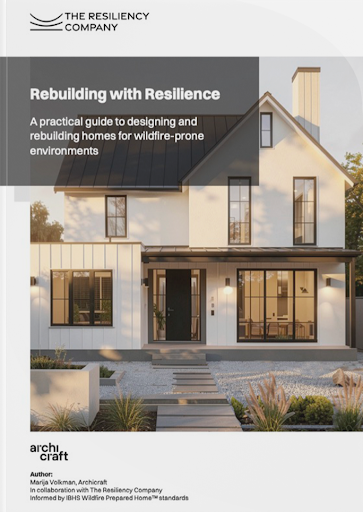
This is the 6th part of our series on designing and rebuilding homes for wildfire-prone environments, informed by our manual, Rebuilding with Resilience. For more in-depth content, we recommend reading chapter 5.
Building a fire-resistant home is the first half of the equation; the second is maintaining what you’ve built. Compliance with wildfire resilience standards requires ongoing inspection and upkeep, because even compliant assemblies can fail if debris accumulates, vegetation encroaches, or protective details deteriorate. Post-fire investigations repeatedly show that ignition often results from neglected upkeep that kept materials from performing, rather than material selection alone.
It’s important to inspect the property at least annually, ahead of peak fire season, to make sure that every investment you make in fire resilience is able to do its job. To meet the IBHS standard, an annual check-in is required, followed by a recertification in year 3. When inspecting your home, here’s what to look for:
Roof surfaces, valleys, and roof-to-wall intersections are free of accumulated leaves and debris.
Required non-combustible zones are clear of vegetation or stored materials.
Gutters are empty and functioning properly.
Ember-resistant vents are unobstructed and undamaged.
Decks, stairs, and areas beneath attached structures are free of combustible debris.
Fence-to-building transition zones remain compliant.
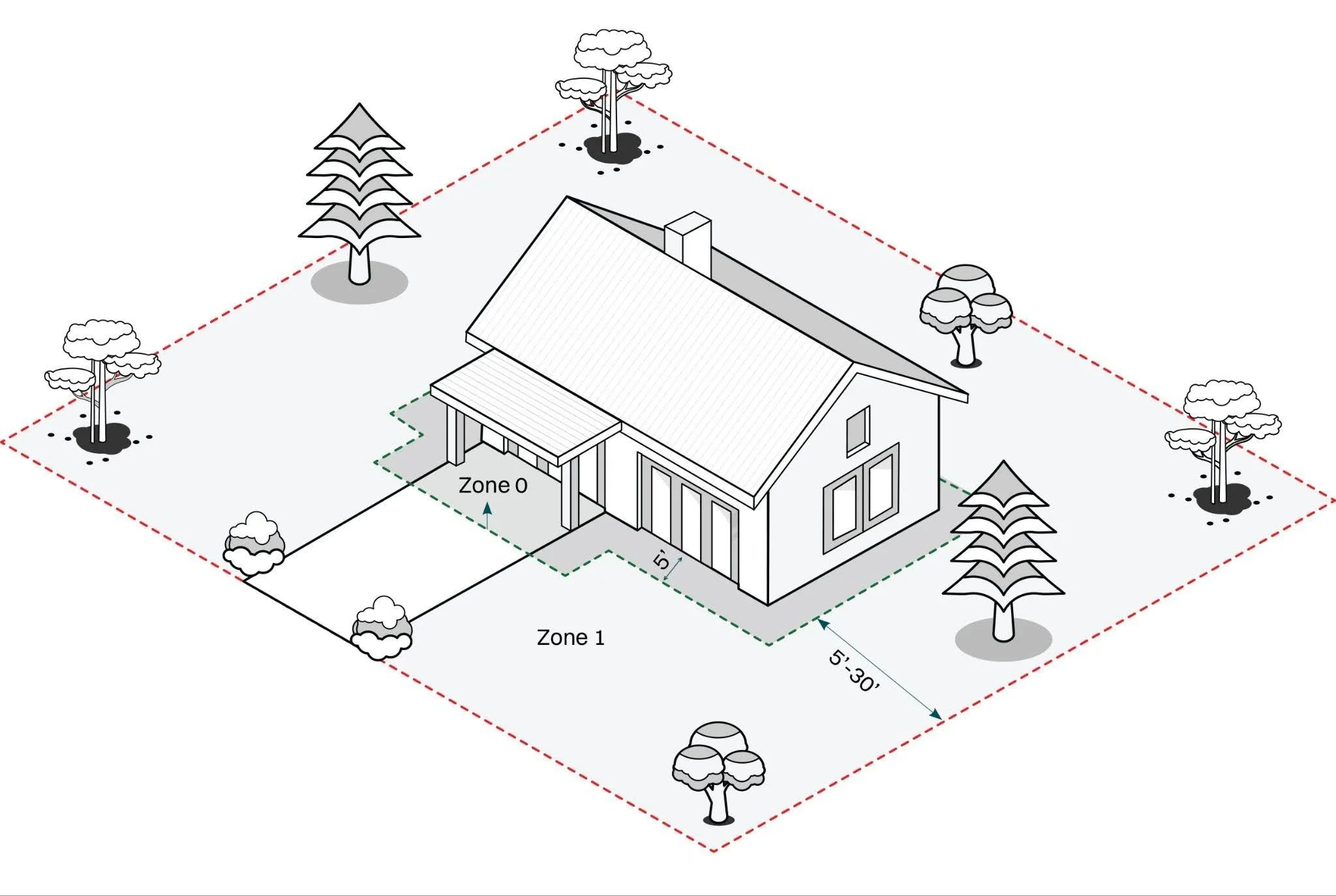
Weeds and dead leaves build up gradually, so it’s easy not to notice. Staying on top of them protects the work you’ve already done to remove fuel pathways and keep a clear Zone 0. Significant wind events can also leave large amounts of leaf and tree litter. The following should be done regularly, and especially after storms:
Remove leaves and pine needles from your roof and the base of your walls.
Remove debris from beneath your decks and stairs.
Remove any vegetation encroaching into Zone 0, whether it’s weeds or your landscaping plants growing beyond their original boundaries.
Check for accumulations of leaf litter or weeds along fence lines or at structural attachments.
Beyond what blows or grows in your yard, paying regular attention to the building components themselves is also needed as small mechanical failures, cracks, or warps can open the door to ember intrusion. This means making sure every window and door can close tightly, with all seals and weatherstripping intact. Mesh screens fit the dimensions of their opening exactly and any flashing and non-combustible base protection remains continuous, without gaps or cracks. While fire resistant coating and treatments are not a substitute for non-combustible material choices, they degrade over time, where installed it should be intact.
Finally, beyond routine maintenance and upkeep, it’s important for homeowners to take special action during Red Flag or high-wind fire conditions, when embers can travel fastest and farthest. Taking a few deliberate steps around the property on these days can make an outsized difference in whether a stray ember ignites or peters out.
Homeowners should:
Remove furniture cushions or decorative items within five feet of the home.
Move trash bins inside the garage or away from structures.
Move cars inside the garage or away from structures.
Relocate portable firewood and combustible materials at least 30 ft away from the building.
Close all doors and windows.
Confirm that decks and stair areas are clear of debris.
Taken together, these habits—annual inspections, regular debris clearing, attention to seals and screens, and extra precautions on Red Flag days—ensure that every element of your resilient build works as it should. As we’ve discussed in earlier articles, this system and approach works to slow fire’s spread, prevent it from reaching your home, and, if it does arrive, keep it out. Design establishes the system, and maintenance preserves its performance.