Rebuilding vs. Retrofitting to Resilient Standards: What’s Right for Los Angeles Homeowners?
Understanding the costs, benefits, and timing of two approaches to wildfire protection.
Key Takeaways
Homeowners who want a safer, more insurable home after the Eaton and Palisades fires have two options: rebuild to existing codes and retrofit later or rebuild a more wildfire-resilient home from the start.
Rebuilding to a higher safety standard is less expensive than homeowners realize and provides better protection relative to the retrofitting path.
To make the decision between rebuild versus retrofit, homeowners should ask themselves five questions.
In the wake of the Eaton and Palisades fires, homeowners overnight became builders, contractors, architects, etc.—forced to confront questions of design, building codes, and landscaping.
This was not something anyone chose, and no one wants to go through this twice, leading many homeowners to weigh two options in rebuilding:
Retrofit Later: Rebuild to code and retrofit later with materials and components that improve wildfire safety
Resilient Now: Rebuild a fire-safe home from the ground up that incorporates protection against future wildfires, but exceeds baseline requirements.
In this article, we dive into the pros and cons of each approach, equipping homeowners with a framework to make the best decision for their families and long-term safety.
Option #1: Rebuild to Code and Retrofit Later
Retrofitting a home for wildfire safety means modifying an existing structure to better withstand future fires. In this scenario, homeowners would build to current building codes and then, over time, upgrade specific features—the windows, decks, vents, siding, gutters, landscaping, and more—to reduce the risk of future damage. And making these upgrades is essential, as current building codes are only a minimum legal requirement, not a suggested safety benchmark.
The Insurance Institute for Building & Home Safety (IBHS) in 2022 created the Wildfire Prepared Home (WPH) program, outlining specific, science-backed actions homeowners can take to harden their homes against wildfire risk.
The WPH program comes with two designation levels: Base and Plus. The Base level offers a foundational set of recommendations focused on defending against embers, the leading cause of home ignitions and is often achievable by retrofitting. The Plus standard builds on the Base foundation, adding features and elements designed to protect your home from more intense threats, including radiant heat and direct flame contact.
For some homeowners, retrofitting is an attractive option because:
Retrofitting requires less upfront capital: Insurers typically cover code upgrade costs, but not beyond, meaning a homeowner may not have to come out of pocket to rebuild what existed before.
Retrofitting gives families financial flexibility: Homeowners can make smaller adjustments over time to improve wildfire resilience, when and as they have capital available.
Retrofitting does, however, have some drawbacks. The most notable are:
Retrofitting can cost more down the road: Homeowners will typically spend between $2,000 and $15,000 to meet California’s building code for wildfire resistance—with simple adjustments like adding ember-resistant exterior vents, metal flashing, and gutter guards—but could spend up to $100,000 to rebuild to the highest safety standard.
Retrofitting can be logistically complex: Homeowners have to work around existing structures and replace components earlier in their lifespans.
Retrofitting can be disruptive: The family may be living in the home while repairs and construction are underway, which means co-existing with noise, mess, and contractors.
Retrofitting can take too long: Homes may not be ready for the next wildfire if retrofits take too long, especially given that the frequency of large-scale disasters is increasing.
And because foundational elements may not meet current science-based wildfire standards, achieving even the Base designation may require significantly more time, energy, and money than it would to incorporate fire safety strategies from the start.
The bottom line: Retrofitting is not to be dismissed as an option for homeowners who aren’t able to cover the costs of a fire-resistant rebuild upfront. But it can also produce a less fortified home for what ends up being a comparable, or sometimes costlier, investment.
Option #2: Rebuild a fire-safe home from the ground up
The second path to a safer home is to rebuild with wildfire safety in mind from the beginning. This means constructing a new home to one of the Wildfire Prepared Homes program standards, rather than making upgrades to a home built to standard building codes.
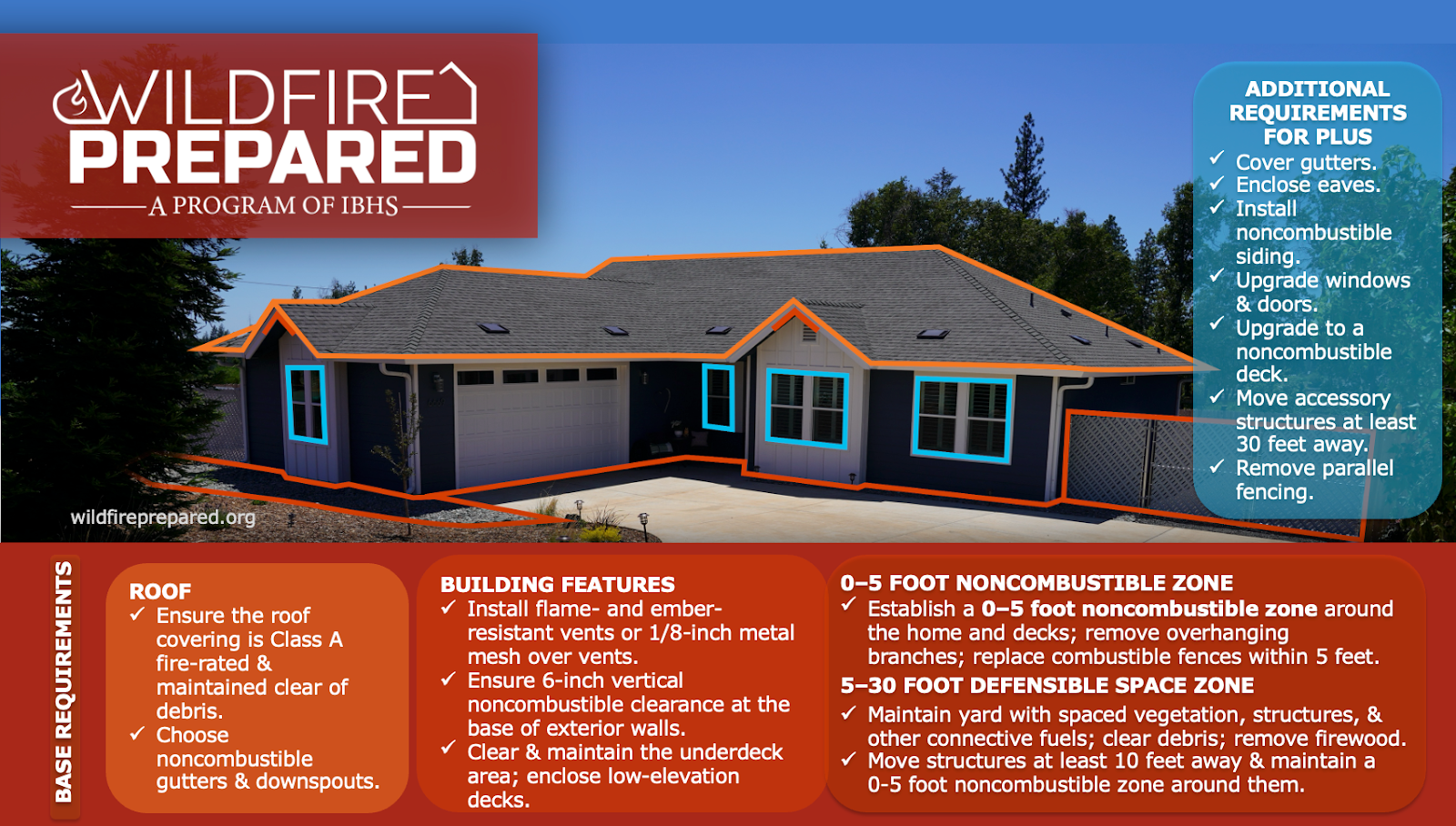
The WPH Plus designation, the highest evidence-based safety standard available, is easiest to achieve when starting from the ground up. Homeowners can make decisions about fire-rated components, like installing a noncombustible deck and using noncombustible siding, at the outset, when the walls are open and the yard is a blank slate.
Not only is rebuilding the least disruptive moment to harden a home against wildfires, but it’s also surprisingly cost effective.
Rebuilding may not mean a significant increase in construction costs: Headwaters Economics found that adopting WPH Plus standards may only add up to 3% to traditional construction costs—between $10,000 and $15,000—to the total cost of rebuilding. This is the most affordable moment it will ever be to upgrade a home, especially compared to the costs of retrofitting (up to $100,000 to meet the same level of protection). The rebuilding moment is the most affordable it will ever be to achieve the highest safety standard possible.
Rebuilding with fire safety in mind may help the new home maintain, or even appreciate, in value over time: A 2025 study from the University of Pennsylvania found that homes built to the basic California wildfire-resistant code (i.e., after the early 1990s) sell for 1.4% to 2.5% more than homes built before the policies were enacted. It stands to reason that a WPH Plus designation could increase resale potential even more.
Rebuilding can mean better insurance pricing and coverage: Estimates from Insurance for Good show that those who rebuild to the Plus standard save approximately 21% on premiums.
Rebuilding with resilience has a high ROI: Every $1 invested in rebuilding communities to be wildfire-resistant could save up to $210 in future damages, according to Headwaters Economics.
It’s also worth noting that wildfires don’t just affect individuals; they impact entire communities. A house may ignite when embers blow off nearby structures. When multiple homeowners on the same block adopt the same safety guidelines, the entire neighborhood becomes easier to insure, simpler for firefighters to defend, and more secure for everyone who lives there. The decision to rebuild with resilience doesn't just protect one home; it protects entire neighborhoods.
Where to start: Five questions to guide your decision
The choice between rebuilding and retrofitting isn't one-size-fits-all. Start by asking yourself these five questions:
What are the costs, and when will you pay them? Get specific estimates now for both paths: rebuilding to WPH standards now versus rebuilding to code and retrofitting later. The difference is in both total cost and the timing of when those costs are incurred. Ask contractors for line-item estimates for both scenarios.
What does your insurance cover for reconstruction? Understanding your coverage determines your starting point. If your policy includes code upgrade coverage—replacement at current building standards—you have a foundation to build from. Contact your insurance adjuster to clarify what's covered and what would require additional investment.
Will your lender offer additional financing or other benefits if you rebuild with resilience? Some lenders, like Bank of America, are providing support specifically for homeowners affected by the fires. For its existing mortgage clients affected by the fires, Bank of America’s Rebuild Solution offers extended forbearance by up to two additional years for clients who plan to rebuild their home, a rebuilding line of credit to help cover rebuilding costs not fully covered by insurance, and the ability to preserve the client’s current lower interest rate on the underlying mortgage.
How long do you plan to stay in this home? If you're planning to live here for the next 10-30 years, the long-term benefits of rebuilding to WPH Plus—lower insurance premiums, reduced risk, increased home value—compound over time. If you're uncertain about staying long-term, consider how a WPH Plus designation could make your home more attractive to future buyers in an increasingly risk-conscious market.
What are your neighbors doing and what have they learned? Talk to your neighbors about their plans and what they’ve learned in their research. When multiple homes on the same block adopt wildfire safety standards, there are opportunities to reduce community risk, increase the likelihood of insurance coverage, and create a more defensible neighborhood.
Ready to Take the Next Step?
Whether you choose to rebuild or retrofit, you don't have to navigate this alone. Visit the PILLAR platform to explore financing options that can help bridge the gap between standard reconstruction costs and wildfire-safe rebuilding.
You can also consider other types of financial support, such as SBA disaster loans, statewide grants, and PACE loans, or ask your lender about programs and products that are geared towards resilient rebuilding.
The path forward starts with understanding your options. Whatever you choose, choosing to rebuild with wildfire safety in mind means you’re making an investment that will pay dividends.