
How Homes Actually Burn
What wildfire science tells us about the structures we're rebuilding
Key Takeaways
Embers, not direct flames, ignite most homes by exploiting small vulnerabilities.
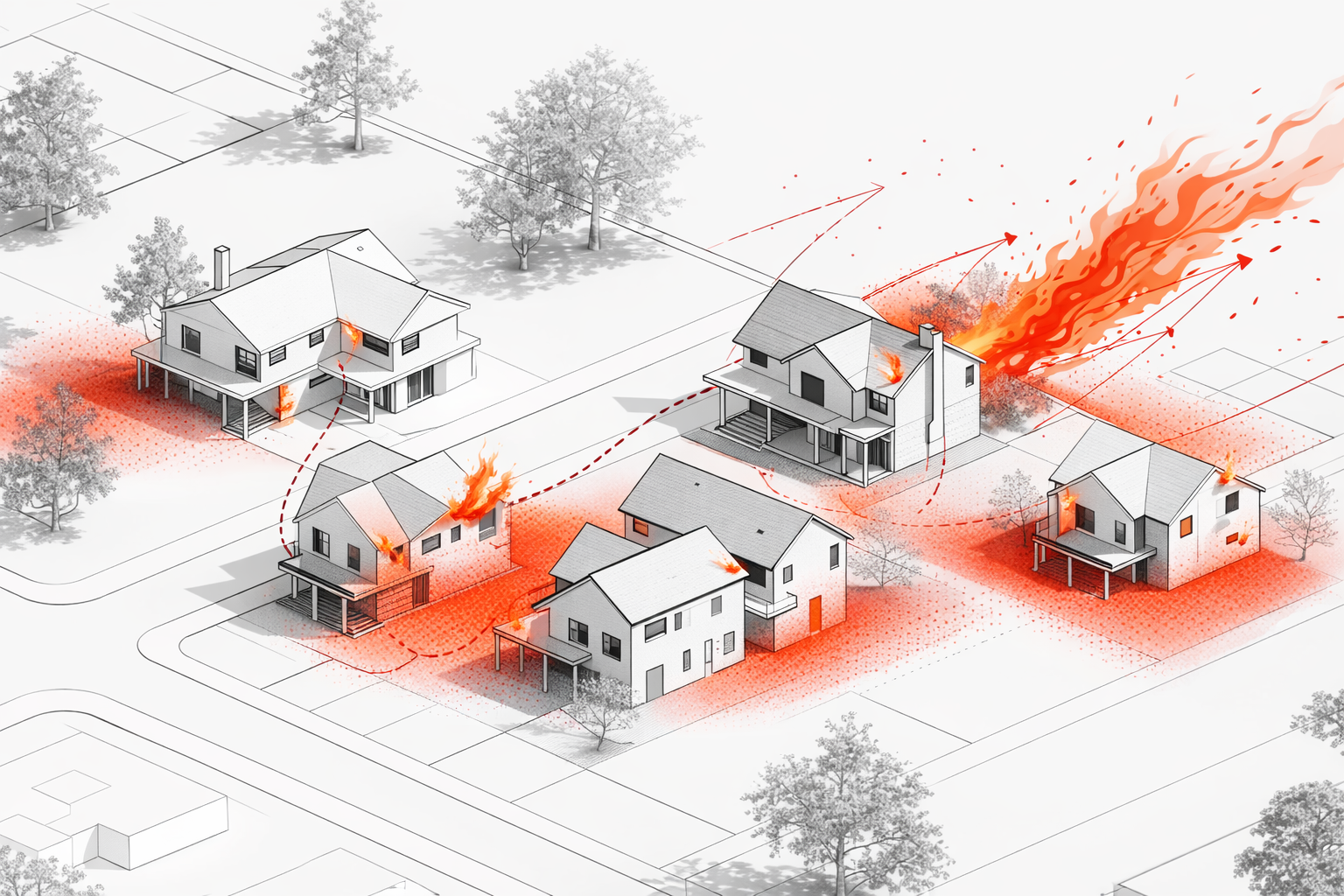
Proximity drives fire spread: Nearby burning materials and closely spaced structures allow flames and heat to move from home to home.
Resilience requires going beyond code: Wildfire survival depends on coordinated design that removes ignition pathways, not just on individual minimum compliance.
This is the 1st part of our series on designing and rebuilding homes for wildfire-prone environments, informed by our manual, Rebuilding with Resilience. For more in-depth content, we recommend reading chapter 2.
At the end of this article, we also share an interview we conducted with Laura Blaul from IBHS that expands on key ideas presented below.
In a wildfire, homes rarely burn from a wall of flames sweeping toward and engulfing a home. Instead, homes burn from fire exploiting subtler weaknesses in the structure — like small gaps or connected, combustible materials catching fire. Protecting your home from the next wildfire requires understanding how it could actually ignite.
Rebuilding with Resilience is a practical guide produced by the architecture firm Archicraft in collaboration with The Resiliency Company and informed by IBHS Wildfire Prepared Home™ standards. It breaks down the science of wildfire exposure in detail, demonstrating exactly how buildings most often burn and how you can fortify your next home to better withstand disaster.
Here's what the research shows:
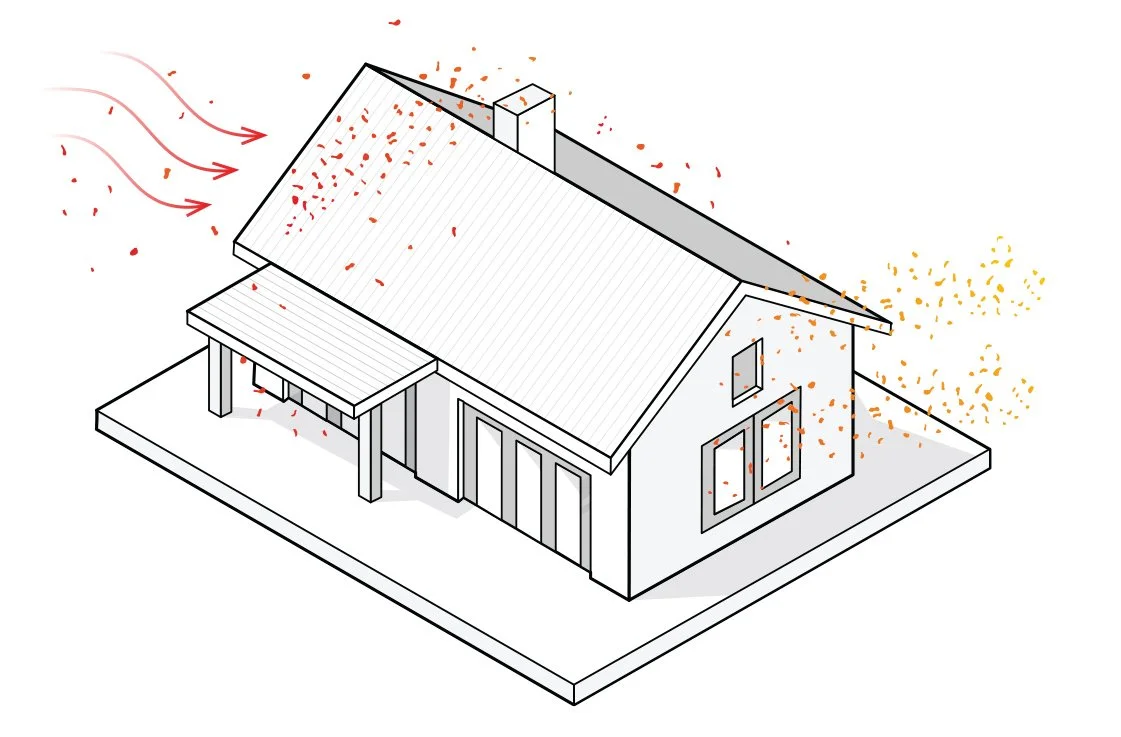
Wind-Driven Embers Are the Leading Cause of Home Loss
During most wildfires, wind is what determines spread: It picks up embers and carries them far ahead of the flame front, scattering them across rooftops, decks, vents, vegetation, and fences. When these embers reach vulnerable locations, they may encounter organic fuel like leaves or debris or remain lodged in place long enough to heat the surrounding material to the point of ignition.
Common ember entry points include:
Roof edges and gutters
Vent and open eaves
Deck surfaces and under-deck areas
Base of exterior walls
Fences, pergolas, and attached structures
Because vulnerable locations are often out-of-the-way places, a stray ember can kindle a fire before anyone notices.
Embers Become Direct Flames With Proximity and Time
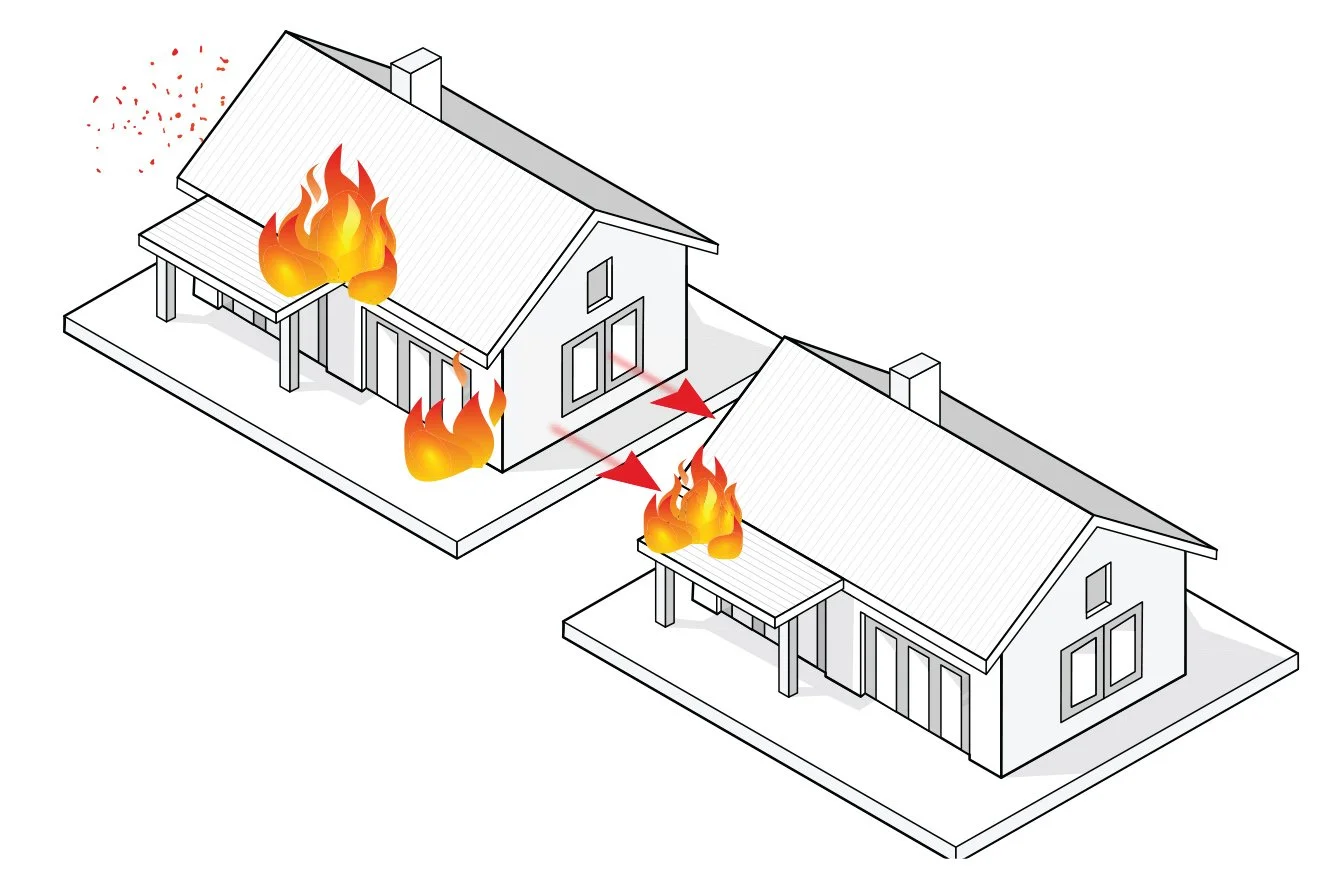
Once an ember ignites a fence, a hedge, a deck surface, or stored material, a home’s direct exposure to flames occurs. And fire doesn’t need to be a towering inferno to be dangerous. Flames coming into consistent contact with a house often initiate a slow, close burn. The risk then is determined less by peak fire intensity and more by how long burning materials maintain contact with the structure.
Direct flame contact typically occurs when:
Vegetation, fences, or accessory structures ignite.
Fire spreads via connective fuels like vegetation or wooden decks to the home.
Structures are placed too close together.
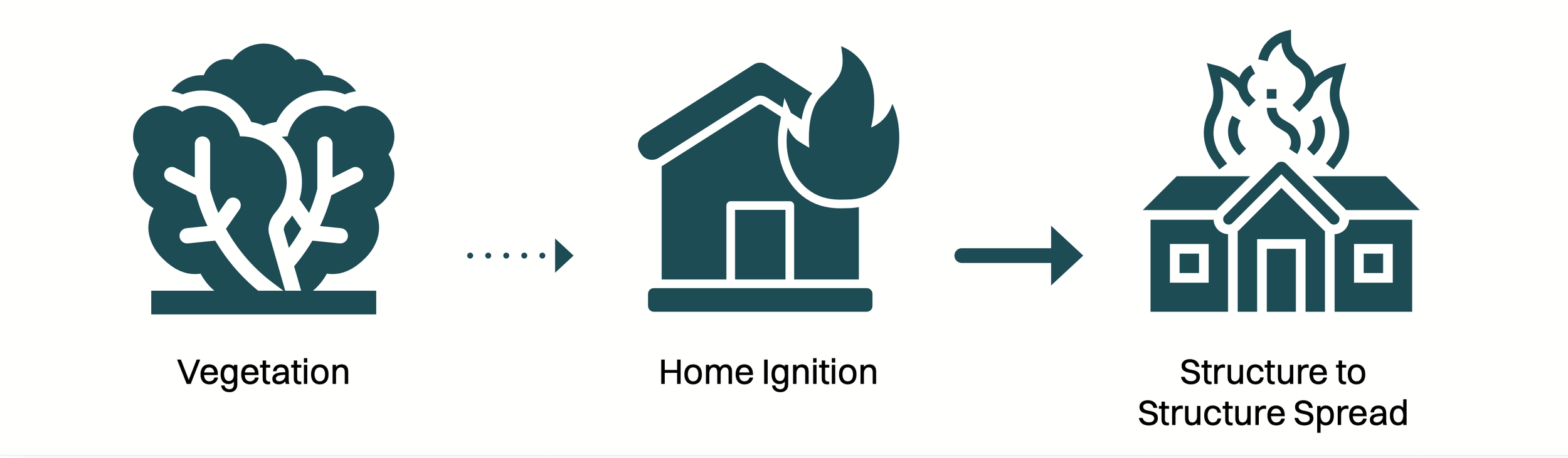
In dense neighborhoods, spreading flames cause structure-to-structure ignition. At this stage, what began as scattered ember ignitions becomes continuous fire as wind stretches flames, triggering a sort of domino effect between homes and throughout a neighborhood.
Radiant Heat is a Multiplier
Laura Blaul, IBHS
“A well-hardened home surrounded by vulnerable structures still faces elevated risk.”
A burning building, deck, or vegetation emits intense thermal radiation — energy that travels outward and is absorbed by surrounding surfaces. Those surface temperatures then rise, sometimes so high that they melt or catch fire from the heat alone.
At elevated temperatures:
Glass can crack or shatter.
Vinyl components can soften and deform.
Sealants and weather barriers can fail.
Combustible materials can dry, preheat, and eventually ignite.
Once materials soften or crack, new gaps and vulnerabilities emerge, allowing embers or flame to enter the structure. Homeowners can't control how close their neighbors' homes sit to theirs, but they can control how their house responds when radiant heat and flying embers show up and potentially reduce the risk of simultaneous exposure events. That’s why taking a layered approach to wildfire resilience is so important.
Homes Become the Primary Fuel Source for Fire
In a forest, plants, trees, and debris keep a wildfire going, but once a fire reaches a residential area, homes and their immediate surroundings become the primary fuel source. Decks, fences, exterior wall finishes, attached structures, stored items, and nearby accessory buildings often create continuous pathways that allow fire to spread from the landscape to structure, and then from one structure to the next. These pathways, also called connective fuels, enable wind-driven embers and flames to move through residential areas. Even small, insignificant-seeming combustible elements — like a decorative corbel — can link to larger fuel sources. Most large residential losses result from this chain of connected ignitions rather than a single point of failure.
Building to Code Isn't Enough
Building codes play an important role in reducing wildfire risk; however, many current provisions don’t incorporate the latest research on how fire spreads in a built environment. They don't fully account for prolonged exposure from adjacent burning structures or the cumulative radiant heat produced when multiple structures ignite in sequence. They focus on individual building components, like roofing, vents, and defensible space, rather than resilience as a coordinated system.
IBHS research shows:
Homes that survive interrupt structure-to-structure spread.
The space between buildings matters as much as the building materials.
Individual building performance directly influences neighborhood fire spread.
The most important insight from post-fire research is that homes that survive do so because ignition pathways were interrupted. Homes that fail do so at predictable locations. The difference is rarely luck; it is design and preparation.
Resilience Is in the Design Details
For homeowners rebuilding after the LA fires — and for architects, builders, and developers working in fire-prone regions across the U.S. — the Rebuilding with Resilience guidebook offers a full framework that bridges the gap between what wildfire science tells us and how we too often build. It explains how resilient design identifies and removes the small weaknesses that allow fires to catch and grow and how incorporating fire safety measures, from material selection to architectural choices to landscaping, reduces long-term risk and helps keep the home insurable.
In our next post, we’ll be exploring why having a layered defense strategy improves wildfire resilience significantly. Sign up for our newsletter here, and get the full manual here.
Real Questions, Real Answers
In Conversation with Laura Blaul from IBHS
Question 1: The "Ember Myth"
In your field research, what is the most surprising or overlooked everyday object (like a door mat, planter, or fence) that acts as an accidental "landing pad" for embers?
One of the most overlooked ember traps is the 5' immediately around the home itself. Embers frequently ignite combustible items such as mulch, decorative bark, patio furniture cushions, doormats, stored firewood, and even well-hydrated vegetation. Trash cans and fences are another common culprit. We've seen embers ignite a wood fence hundreds of feet from the main fire, allowing flames to travel directly to a home. In many cases, the ignition pathway starts with something small and seemingly harmless rather than a dramatic wall of flame.
Question 2: The Domino Effect
You’ve likely seen how fires transition from the landscape to becoming a chain reaction between structures. How should homeowners view their relationship with their neighbors' property when it comes to radiant heat and "connective fuels”?
Wildfire resilience is rarely an individual property issue. Once a fire enters a neighborhood, homes can become fuel for one another through radiant heat, direct flame contact, and ember exposure.
Homeowners should think of their property as part of a larger system. A well-hardened home surrounded by vulnerable structures still faces elevated risk. Neighborhood-scale actions—reducing vegetation, limiting connective fuels like continuous wood fencing, and encouraging home hardening across the community—can be just as important as the improvements made on a single parcel.
Question 3: Beyond the Code
Standard building codes often fail to look at a home as a "coordinated system." From a scientific standpoint, why is a holistic design approach so much more effective than just checking off standard code requirements?
Building codes typically address individual components—roofs, vents, siding, windows, decks—but wildfires test how those components perform together as a system. A home may have a Class A roof, for example, but still be vulnerable if embers enter through vents or ignite combustible materials adjacent to the structure. A holistic approach recognizes that wildfire exploits the weakest link. When every component works together to interrupt ignition pathways, the home becomes significantly more resilient than any single code-compliant feature could achieve on its own.
Question 4: The Power of Detail
A home's survival often comes down to tiny design details rather than luck. If a homeowner rebuilding right now could make just one small architectural or material adjustment to interrupt an ignition pathway, what should it be?
If I could recommend one adjustment, it would be creating and maintaining a noncombustible zone immediately adjacent to the home—often referred to as the first five feet or Zone 0. Moving or removing vegetation, replacing mulch and other ignitable materials with noncombustible surfaces such as gravel, stone, concrete, or pavers can eliminate one of the most common ignition pathways. It's a relatively simple change that can have an outsized impact on a home's ability to withstand an ember storm.
Question 5: Looking Ahead (The Sneak Peek)
Our next article focuses on the Layered Defense Strategy and coordinating design decisions across a property. To give our readers a sneak peek, why is it a mistake to rely on a single "fireproof" material, and how does looking at a home in defensive "layers" fundamentally change its odds of survival?
There is no such thing as a completely "fireproof" material or product. Wildfire is a system problem, and resilience comes from layers of protection working together. A fire-resistant roof helps, but not if embers enter the attic through unprotected vents. Ember-resistant vents help, but not if flames reach a window or deck. A layered defense strategy addresses multiple ignition pathways simultaneously—from the surrounding landscape, to the immediate perimeter of the home, to the building materials themselves. Each layer reduces risk, and together they dramatically improve the odds of survival during a wildfire.