Material Choices for Wildfire-Resilient Rebuilding: A Homeowner's Guide to Meeting the IBHS Wildfire Prepared Home Plus Standard
Understanding material specifications is critical for building a safer, more insurable home.
Key Takeaways
Understanding material specifications—not just brand names—is essential for meeting the IBHS Wildfire Prepared Home Plus standard
The most common confusion occurs around doors, decking, windows, and understanding the difference between "fire-resistant" and "non-combustible"
Working with your architect and contractor to document specific material requirements ensures materials aren't swapped out during construction
In the wake of a wildfire, rebuilding can feel like a blur of decisions. There’s insurance paperwork to file, temporary housing to find, design meetings to coordinate, permits to obtain—hundreds of choices layered on top of grief, fatigue, and financial stress.
Yet for all its difficulties, this moment also presents a rare opportunity to build a home that is safer, more insurable, and more resilient than the one that burned. Understanding how wildfire-resistant materials actually work, and what fire safety standards require, can turn a confusing process into the chance to create a home that’s better equipped for the future.
What Does “Meeting the Plus Standard” Actually Mean?
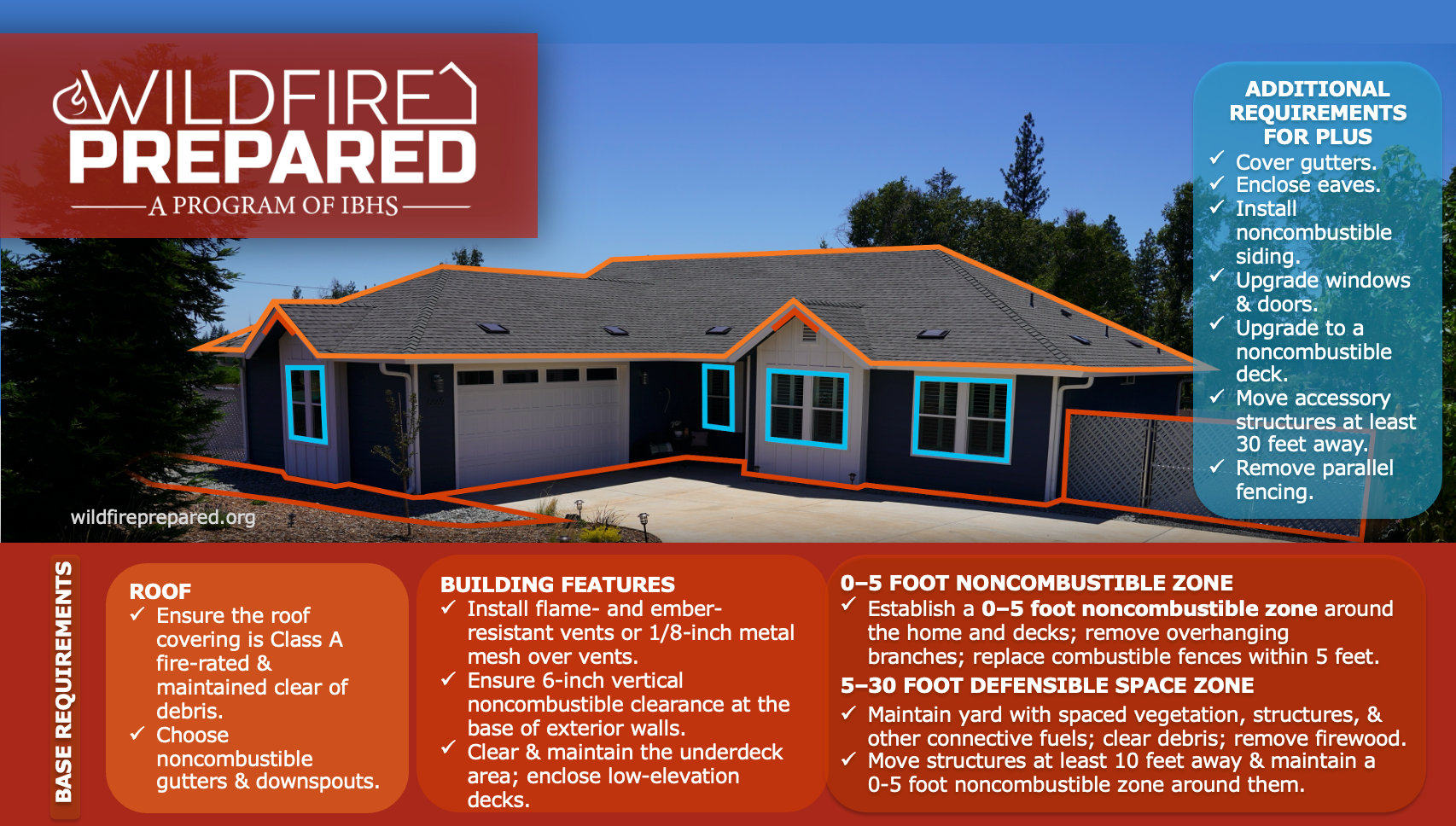
The Insurance Institute for Business & Home Safety (IBHS) offers one of the highest fire-resistance certifications available: Wildfire Prepared Home Plus (WPH+). The WPH+ standard lays out specific requirements for key building components, from roofing and siding to decks, vents, and doors. Don’t worry about memorizing brand names or chasing specific products; it’s most useful to familiarize yourself with the performance characteristics resilient materials must meet.
A simple framework helps:
Requirement: The safety goal to be achieved (for example, “non-combustible material within five feet of the home”)
Specification: How that requirement is implemented in your project
Product: The actual item installed
Test standard: How its performance is verified
Products and codes change, but if your plans clearly specify performance requirements, your architect and contractor can easily identify compliant materials.
Decoding Key Fire Safety Terms
Fire-safety terms are often used interchangeably, even though they mean very different things.
Here’s a quick guide:
Non-combustible means the material doesn’t burn, period. It won’t ignite. It won’t become fuel. Concrete, stucco, masonry, steel, aluminum, and glass are all non-combustible. Wood and plastics are not. They burn, even when treated with fire-retardant coatings or treatments.
Fire-resistant is not a formal code term. It’s usually marketing language that means a material resists fire better than others, but still burns; crucially, fire-resistant does not mean non-combustible. Real performance depends entirely on testing.
Fire-rated means a material or assembly holds up against fire for a specific amount of time; it can be rated to 30 minutes, one hour, two hours, etc. These ratings usually apply to assemblies, not single materials, and can include combustible components.
Fire-retardant refers to wood or plastic that’s chemically treated to burn more slowly. It is still combustible, and most testing focuses on flame spread, not ember exposure. Treatments can also degrade outdoors; for all these reasons, fire-retardant does not mean wildfire-safe on or near a home.
These distinctions matter and are most important when choosing materials for areas where embers can accumulate and ignite. Anything that can burn places a home at risk, regardless of how long that material can resist flames.
The Essential Building Components
Each major building element has specific performance requirements. Once you understand the basics, identifying WPH+ compliant materials and incorporating them into your design becomes easier.
Roofing. Roof coverings must have a Class A fire-resistant rating. Many compliant roofing options exist, including tile, certain asphalt shingles, and metal.
Windows. Windows must be dual-pane, dual-tempered glass. More and more manufacturers are starting to offer compliant windows, making this component easier to source.
Doors. Doors must be made of a noncombustible material or solid-core wood at least 1¾ inches thick. Any glass in the door must be dual-pane, dual-tempered. Homeowners have a wide range of compliant door choices.
Decking. All decking, posts, rails, and nearby siding must be non-combustible, not merely flame resistant. This one is tricky as not many deck systems meet the requirements, and those that do are often expensive. As a result, many homeowners choose concrete patios with iron railings or glass sides instead.
Siding. Siding must be non-combustible. This is generally straightforward: stucco, brick, concrete, fiber-cement board, masonry veneer, and similar products all fulfill the guidance and are widely available.
Vents and gutters. Vents should be manufactured to be ember and flame resistant, or homeowners should cover vent openings with ⅛” metal mesh, including on roofs and foundations. Gutters need non-combustible covers. Most builders now implement these automatically. Don’t forget forced air vents; a self-closing metal flap prevents ember entry.
Eaves. If your home has eaves, the underside must be enclosed with non-combustible material to prevent embers from getting trapped and igniting.
Fencing. Within five feet of the home (or, inside “Zone 0”), fencing must be non-combustible. Beyond that, there’s more flexibility.
Click here for a more detailed look at all material requirements across the CA WUI Part 7, Wildfire Prepared Home Base, and Wildfire Prepared Home Plus standards.
How to Work With Your Rebuilding Team
To ensure your finished home actually satisfies WPH+ standards, there are a few steps you should take.
First, include WPH+ notes in your plans, clearly stating your intent to build a compliant home and receive certification.
Plans should also specify the performance requirement of the materials you’ll use, not just the brand or general category: For example, say “flame and ember-resistant vent”; not “gable vent.” That is enough to put your rebuilding team on notice.
Creating this type of record…
Lets your contractor know exactly what specification to bid on
Minimizes the risk that the wrong materials will be used
Can help you secure insurance discounts further down the line
As you work with your architect or builder, make sure you’re confirming that the materials selected precisely fit the guidelines you’re working toward. Helpful questions to ask include:
“Is this decking non-combustible or just flame resistant?”
“Are my eaves and soffits enclosed or covered in non-combustible materials?”
“Do I have decorative materials on my exterior, and are they noncombustible?”
“If my Spanish roof tiles have open gaps, does the design include noncombustible bird stops at the edges to prevent ember intrusion?”
“Are these windows dual-pane, dual-tempered glass? Do they have the visible corner etching that indicates tempered glass on both panes so I can verify compliance?"
“Is my non-combustible 0-5’ zone clearly identified? If I don’t have five feet between my home and property line, is my neighbor willing to work with me on a non-combustible zone on their side of the fence?”
"Are there hybrid fencing solutions that use non-combustible materials near the house, like wood-look metal within five feet, and transition to other materials, like wood-look vinyl beyond five feet, while maintaining a cohesive look?"
Rebuild for the Future with Confidence
Rebuilding after a wildfire is never simple, but knowledge is one of the most powerful tools homeowners have. When you understand how materials perform and how standards define safety, you gain control over a process that often feels chaotic. These decisions are investments in a more resilient future, for you and for your community.
Photo credit: Wildfire Prepared